When There Are No Dress Codes, What You Wear Matters More
By Raluca Marcu, Image Scientist, Style Coach™ & Founder of Loupe


In Dubai, getting dressed for an event can sometimes be an event in itself.
You receive an invitation. You know the venue, the time and the occasion, but there is one thing missing: a dress code.
And suddenly, the questions begin.
How dressed up is everyone going to be? Is a simple dress enough, or is this the kind of evening where everyone arrives looking ready for a red carpet? Can you wear trainers? Is it a casual gathering or an occasion that calls for a little more glamour?
In a city where a coffee can happen in a hotel lobby, a business meeting can turn into lunch and an evening gathering can move from understated to spectacular, knowing what to wear is not always as straightforward as it sounds.
For a while, it seemed as though dress codes were disappearing. Suits became optional. Trainers entered offices. Gym wear became streetwear. Hybrid work blurred the line between work clothes and everything else.
It was easy to assume that if there were fewer rules, perhaps what we wear mattered less.
The opposite is true.
When the rules disappear, our choices become more visible.
Nowhere is this more apparent than in the UAE, where a single day can take you from a corporate meeting to a café, the school run, a client lunch and an evening event. The old categories of workwear, casualwear and occasionwear no longer always feel particularly useful.
That freedom is, in many ways, a wonderful thing. Women have more room to dress according to their personality, culture, body, profession and lifestyle. We no longer need one narrow definition of what competence, elegance or authority should look like.
But freedom also requires judgement.
Before we say a word, our appearance is already communicating something.
Clothing is only one part of the picture. Posture, facial expression, movement and behaviour all contribute to the way we are perceived. But clothing is one of the most visible signals we give other people.
Our brains are constantly looking for patterns and shortcuts to make sense of the people and environments around us. We register whether the signals we receive feel aligned with the person, the setting and the role.
When those cues fit together, the message is easier to understand. When they clash, they can create friction or uncertainty before we have consciously worked out why.
This is what makes some of today’s biggest fashion trends particularly interesting.
Take activewear. In a city built around convenience, wellness and movement, it makes perfect sense that leggings, trainers and sports sets have become part of everyday life. There is nothing inherently wrong with wearing them outside the gym.
But context changes everything.
The same outfit can feel completely natural in a Pilates studio, perfectly appropriate at a casual brunch, distracting in a business meeting or strangely out of place in a luxury hotel lobby.
The clothes have not changed. The setting has.
And neither has the message we are trying to send.
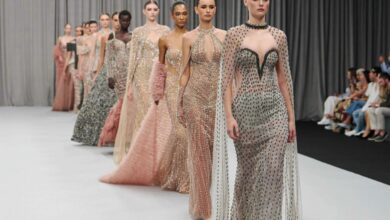
The same is true at the other end of the fashion spectrum. In the UAE, we love glamour, and rightly so. This is a region where fashion, hospitality and occasion dressing are deeply woven into the culture. People make an effort, and that is refreshing.
But there is also a growing tendency for evening dressing to spill into daytime. High shine, dramatic embellishment and heavy occasion styling can appear in settings where the message we actually want to communicate is seriousness, ease or authority.
That does not mean women are “too dressed up”. It means that visual signals do not exist in isolation.
Sparkle can communicate celebration, confidence and femininity beautifully. In another setting, it may simply compete with the message you want people to hear.
This distinction is becoming increasingly important at work.
Workplaces are more casual, more international and less predictable than they once were. A tech founder, a banker, a creative director and a luxury executive may all be dressed appropriately while looking completely different.
In Dubai, there is another layer to consider. Cultural expectations vary from one environment to another, and what feels polished in one setting may feel overly formal in another. What reads as relaxed in one industry can look underprepared in the next.
So perhaps the useful question is no longer, “Is this appropriate?”
The better question is:
What do I want people to understand about me here?
Do I need to signal authority? Approachability? Creativity? Precision? Ease? Respect for the occasion? Belonging? Individuality?
These are more interesting questions than simply asking whether an outfit is “right” or “wrong”.
The most compelling personal style today comes from people who understand the codes well enough to decide which ones to follow, which ones to bend and which ones to ignore.
That does not mean turning getting dressed into another performance we have to manage.
And clothing should never be treated as a shortcut to competence. A brilliant woman does not become less brilliant because she is wearing trainers.
But perception is part of human interaction. Pretending that visual cues do not influence perception does not make us more progressive. It simply makes us less intentional about something that is happening anyway.
Perhaps that is the real paradox of modern dressing.
As the rules disappear, the skill is no longer knowing what you are supposed to wear.
It is knowing what you want to say.