
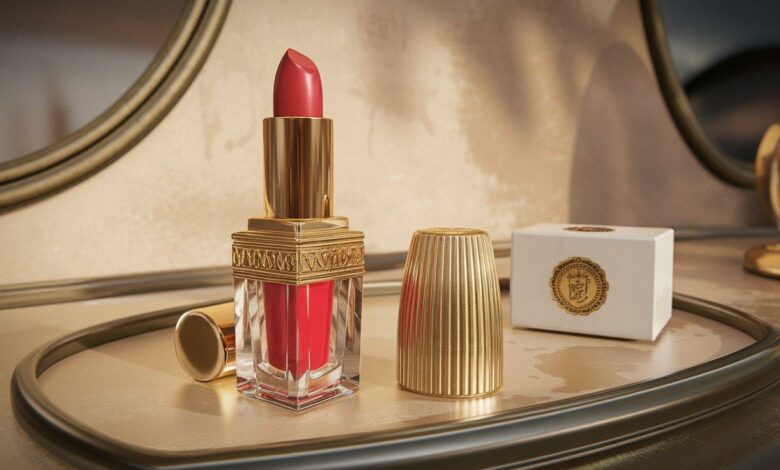
Lipstick is one of the most recognisable beauty products in the world. From classic Hollywood red to today’s nude, berry and glossy shades, it can transform an entire look in seconds.
But lipstick is far older than the modern beauty industry.
Its story stretches back thousands of years to ancient Mesopotamia, where early forms of lip colour were reportedly created using crushed minerals and other natural materials. Ancient Egyptians also embraced cosmetics extensively, using pigments to colour their lips and enhance their appearance.
The story becomes particularly fascinating in Ancient Egypt, where beauty products were connected not only with appearance but also with social status and cultural practices. Men and women both used cosmetics, and elaborate beauty rituals became an important part of Egyptian life.
Explore more beauty stories, trends and timeless inspiration in First Avenue Beauty.
Cleopatra and the Ancient Love of Red Lips
No historical figure is more closely associated with Egyptian beauty than Cleopatra VII.
Although many modern claims about Cleopatra’s exact lipstick recipes are difficult to verify, archaeological and historical evidence clearly shows that cosmetics—including lip colour—were widely used in ancient Egypt.
Red pigments could be produced using naturally occurring materials, while containers, applicators and cosmetic palettes became part of sophisticated grooming rituals.
But these ancient preparations were very different from the lipstick tube sitting in a modern handbag.
For centuries, lip colour appeared in different forms across cultures, but it was not until the nineteenth and early twentieth centuries that lipstick began evolving into a recognisable commercial beauty product.
When Modern Lipstick Was Born
An important turning point came in Paris in 1884, when French perfumers are widely credited with commercially producing a lipstick made with ingredients including deer tallow, castor oil and beeswax.
Early lipstick did not arrive in today’s familiar twist-up tube. Colour was often wrapped in paper or sold in small containers, making application considerably less convenient.
The major breakthrough came in America.
In 1915, inventor Maurice Levy introduced a metal lipstick container with a small lever mechanism that allowed the product to be raised for application.
Then, in 1923, James Bruce Mason Jr. patented an improved swivel-style lipstick case. The increasingly convenient packaging helped transform lipstick into the portable beauty essential we recognise today.
Hollywood Turns Red Lipstick Into a Symbol
Cinema dramatically accelerated lipstick’s popularity.
During Hollywood’s golden age, stars such as Clara Bow, Marlene Dietrich and later Marilyn Monroe helped make dramatically coloured lips synonymous with glamour.
Red lipstick became particularly powerful.
It could communicate sophistication, confidence, rebellion or femininity depending on who wore it and when.
By the mid-twentieth century, major beauty houses were producing an enormous variety of lipstick shades, and the product had become an essential part of the global cosmetics business.
Explore more glamorous transformations and beauty inspiration in Celebrity Style and discover statement beauty looks in Red Carpet.
From Ancient Pigments to Modern Luxury
Today’s lipstick bears little resemblance to the crushed pigments of ancient civilisations.
Modern formulas can include moisturising ingredients, long-wear pigments, matte finishes, oils, glosses and sophisticated textures developed through cosmetic science.
Yet the basic idea has survived for thousands of years: adding colour to the lips as a form of beauty and personal expression.
From ancient Mesopotamia and Egypt to Parisian perfumers and Hollywood icons, lipstick’s history proves that some beauty rituals never truly disappear—they simply evolve.
You May Also Like: Discover more personalities, beauty icons and luxury stories in First Avenue Cover Story.